THE FOUR AOs
Equal weight, 25% each
AO1 develop ideas, AO2 refine through experiment, AO3 record, AO4 present. AQA weights them equally, about 25% each of the GCSE.
See the mark bands grademydoodle
HOW ART GETS MARKED
Art is marked on the journey, not just the final piece.
Read the mark bands
4 × 24marks per component
In GCSE Art and Design, every portfolio and every exam piece is judged against the same four assessment objectives. Research, experiments, drawings and notes all earn marks alongside the finished work.
At a glance
211,369
UK GCSE art and design entries
NSEAD's analysis of 2026 results counts 211,369 art and design GCSE entries across the UK, up 2.3% on 2025 and 3.4% of all GCSEs taken.
ENTRIES · NSEAD, 2026
77.3%
Entries at grade 4/C or above
In 2026, 77.3% of art and design entries reached grade 4/C or above, against 67.3% across all subjects. 23.7% reached grade 7/A or above.
GRADES · NSEAD, 2026
TWO NUMBERS WORTH KNOWING
One figure on how many take it,
one on how the grades came out in 2026.
NSEAD, the National Society for Education in Art and Design, notes that results are one health check on the subject and do not define a teacher or a learner.
THE SIX MARK BANDS
Each objective is marked out of 24 in six bands of four marks. Pick a band to see the word the criteria use and the marks it covers. The bar shows where it sits on the scale.
Based on AQA's published assessment criteria grid for GCSE Art and Design (8201). Other boards use the same four objectives with their own grids.
THE SHORT ANSWER
The four objectives are set by Ofqual
and are the same for every exam board.
THE FOUR AOs
AO1 develop ideas, AO2 refine through experiment, AO3 record, AO4 present. AQA weights them equally, about 25% each of the GCSE.
See the mark bandsDRAWING AND NOTES
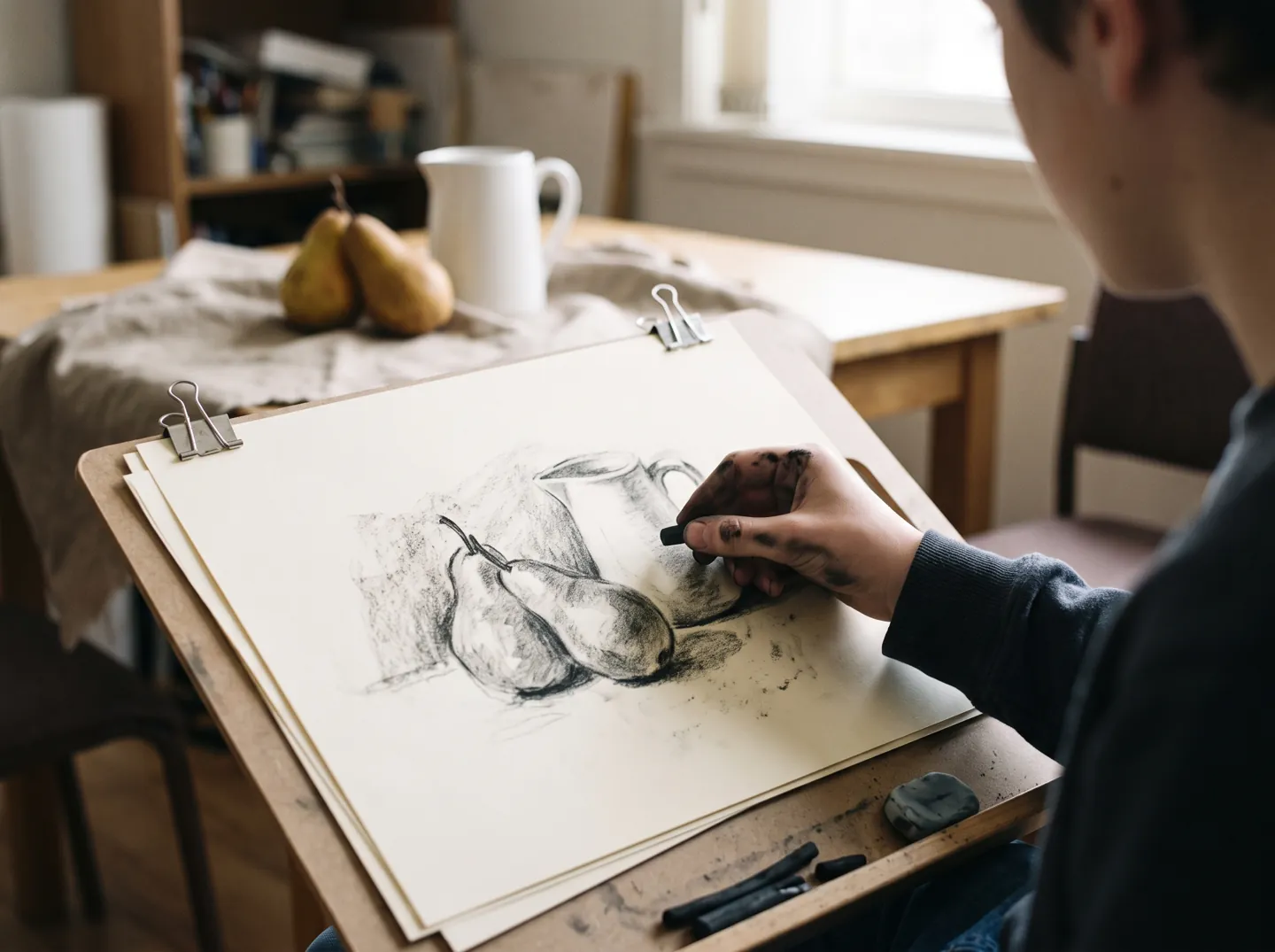
Students must show drawing and written annotation in the portfolio and the exam piece. Both must feature in the evidence for AO3.
How to recordCHECKING MARKS
Teachers mark the work, then a visiting moderator checks a sample and can change marks to bring them in line with the agreed standard.
See the numbers
FOUR HABITS THAT MATCH THE CRITERIA
The criteria reward a visible journey from first idea to final piece. These habits make that journey easy to see.
Study artists, craftspeople or designers and show what you took from them: AO1 asks for critical understanding of sources.
Tests with different media, materials and techniques are evidence for AO2, so keep them rather than tearing them out.
AO3 needs drawing and written notes recorded while the work progresses, not added at the end.
Students must identify and acknowledge any sources that are not their own work.
PORTFOLIO AND EXAM
In AQA's GCSE the portfolio is worth 60% and has no time limit. It must include a sustained project from first engagement with an idea to the realisation of intentions, and it is marked as a whole.
The externally set assignment is worth 40%. Papers are released on 2 January with seven starting points per title; students choose one, prepare, then work for 10 hours of supervised time.
Questions
AO1: develop ideas through investigations, showing critical understanding of sources. AO2: refine work by experimenting with media, materials, techniques and processes. AO3: record ideas, observations and insights. AO4: present a personal and meaningful response.
No. AQA marks the portfolio as a whole, and in the exam component the preparatory studies and the supervised work are assessed together. Each of the four objectives carries 24 of the 96 marks.
No. Drawing can take different forms depending on intention, and the DfE subject content allows students to work entirely in digital media, entirely in non-digital media, or a mix.
After a preparatory period that can begin on or after 2 January, students have 10 hours of supervised, unaided time to realise their intentions. They must stop preparatory work once that time begins.
With AQA, teachers mark both components using the assessment grid, and a visiting moderator checks a sample. Changes to marks normally keep the school's rank order of students.
Sources
ABOUT THIS NAME
grademydoodle.com is part of the DoodleSale portfolio. It isn't in an auction right now, but you can ask about leasing it.